
A Label Too Small: On Being Taken Seriously
When I began this blog sixteen years ago, I stated it was “to put their letters in historical context.” The letters are my grandparents’ WWII correspondence — my grandpa Alex, who I knew until he died in his nineties, and my grandma Sylvia, who died long before I was born and exists for me only in these pages. I didn’t really see how my relationship to them as a granddaughter mattered. I was afraid to be seen in the conversation, and sometimes I still am. This is partly because in my mid-twenties, consumed with worries about adulthood and determination to find love of my own, I had trouble taking myself seriously. And on this blog I was yelling “take me seriously, please!”
I realize more fully now – partially because I’m a mother – that cheesy as it sounds, love is the most serious stuff of all. I know that these letters were more than whimsy, they were critical to survival during a harsh time. They were lifelines for Alex and Sylvia. Even the federal government knew morale was important and letters mattered deeply in terms of national security and the fight against fascism. I wonder how many women have felt this — the compulsion to justify their interest in something, to front-load their credentials before anyone can question their right to care about it. To shrink the personal into the academic because the personal doesn’t feel like enough.
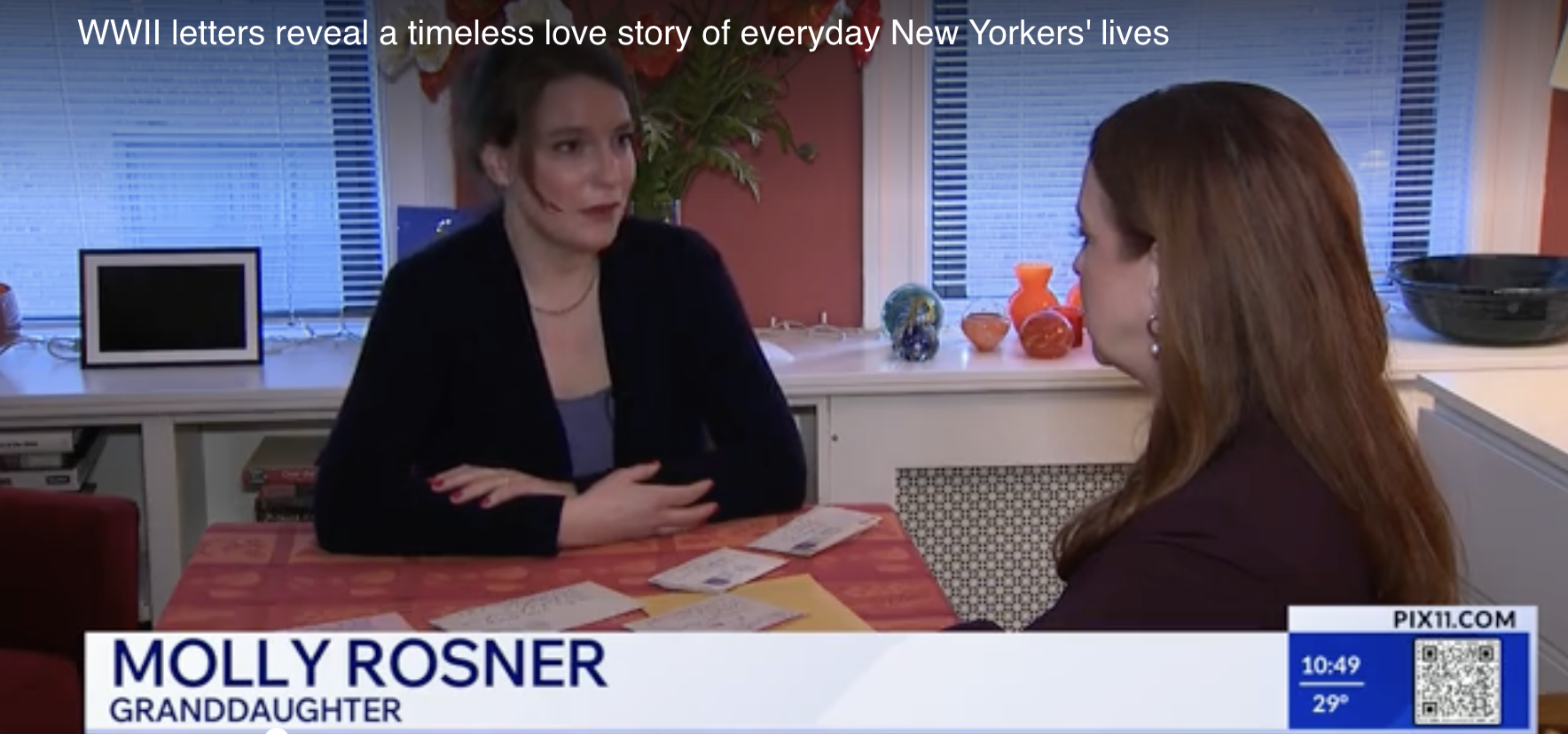
I want to reflect a little on the experience with being on the news last month. It was incredible and exciting for Alex and Sylvia’s story to be shared. I realize the piece was meant for Valentine’s Day and that is what the reporter wanted to highlight. And indeed, their story is romantic, epic, and tragic. The letters are beautiful and they shared something special. This is part of why I’ve often had trouble figuring out my place in this puzzle – how my story, or my reading of their intimate conversations matters.
So back to the news piece, I spoke with the journalist for over an hour going over quotes that I’d selected and talking about my work with the context for the letters, giving her my PhD credentials and the blog URL to share with viewers who wanted to see more.
Then the piece came out. The narration begins with “a Manhattan woman” and when I appear on screen my title on the lower third is “Granddaughter.” Nowhere does it mention that I’m an historian or that I am writing anything about the letters. Erasing me from the story would be one thing, let the letters stand on their own, they’re powerful enough for that! But instead I felt portrayed as a lady of leisure simply reading these letters for giggles and romance. I felt what I feared when I began this blog: like I couldn’t be taken seriously, like my interpretations don’t matter. I didn’t think too much about it until another friend, who has a doctorate and is a professor, grew outraged on my behalf and pointed out that it should have noted I have a PhD. She made the point that there would never be a male historian working on a WWII story whose credentials would be erased or omitted. “Grandson” would not be his title and his book or blog would be incorporated into the story. Small erasures accumulate into bigger ones.
Having now read through the 500 letters multiple times and begun working on a manuscript about them (and me) I’ve been thinking a lot about what conversation I want to be having. April will mark the 16th anniversary of starting this blog, evidence that I’ve been taking this responsibility seriously for most of my adult life. I haven’t been consistent about posting, but I have been consistent about grappling with these letters — publicly and privately, as a graduate student, a researcher, as a surgical patient, a new mother, and now a writer working on a book. I don’t believe that the work I have been doing simultaneously as a historian and a granddaughter exist in opposition to one other. That’s why it is hard to understand leaving out a part of the story.
Sylvia was not “just” a wife and mother — she was a reader, a writer, activist, a woman with ambitions. I am not just a granddaughter — I am finding multiple meanings in what she left behind. She’d want us both labeled more fully. This blog, and the book, are an argument that the titles of “Grandmother” and “Granddaughter” were always too small — for both of us.
*Although the video segment remains unchanged, they honored my request that the description “historian” be added to the transcription below.
Discover more from Brooklyn in Love & at War
Subscribe to get the latest posts sent to your email.

Brooklyn In Love and At War by Molly Rosner is licensed under a Creative Commons Attribution-Noncommercial-No Derivative Works 3.0 United States License.
