
Fainting at Yom Kippur Services
Sylvia describes uncomfortable Yom Kippur services to Alex in 1943:
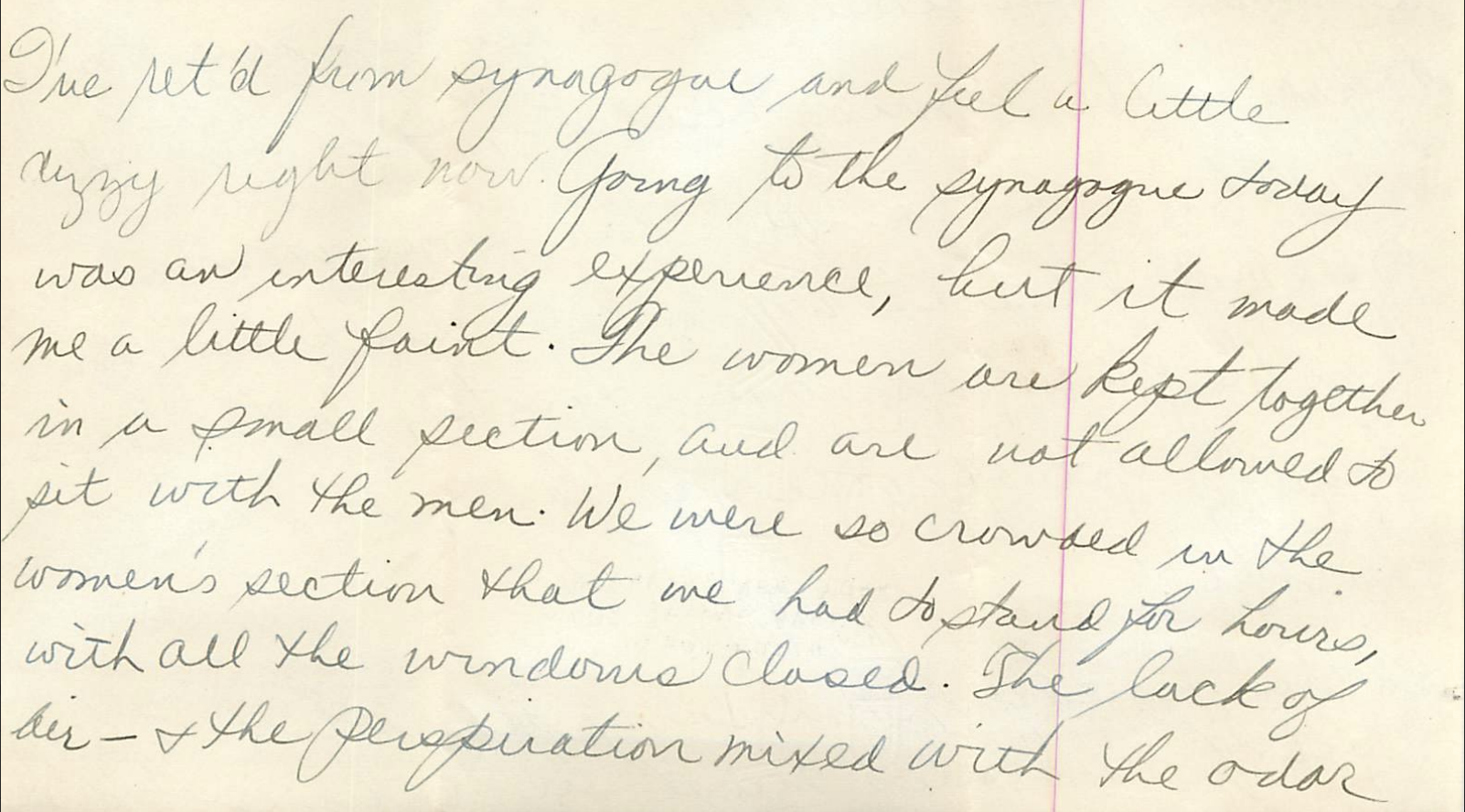
I’ve returned from synagogue and feel a little dizzy right now. Going to the synagogue today was an interesting experience, but it made me a little faint. The women are kept together in a small section, and are not allowed to sit with the men. We were so crowded in the women’s section that we had to stand for hours, with all the windows closed. The lack of air – and the perspiration mixed with the odor of unclean mouths (they are not allowed to even brush teeth) was enough to make a few women fait, while the rest of us developed headaches – and I felt dizzy too. During “Yzikar” quite a number of us made a quick dash for some air. But until “Yzhai” was said, the Rabbi had to collect money from each individual in there, and that took about three hours. The large donations were blessed for a long time, while the small donations also rec’d a 3-word blessing. What a business, it reminded me of an auction sale! They also had a local politician there – and he’s running for office in the coming elections, so he wanted to make a speech too – but some women cried out that it was too late and to prove how tired they were, one woman fainted, so the local bigwig got off the platform, mad as a hornet!

If this bored you, I’m sorry dear, but this sort of business must be entirely different that the one you had at Sampson. If you say you sang the loudest Yisgadal then the ceremony must have been terrific!
***
It’s interesting for me to read this description, having grown up with no religious instruction in either of my parents’ religions. Sylvia is pragmatic in her description, not referring to the services with any detail about what the holiday signifies to her.
Alex is alarmed by her description and writes to her this moving message imploring her to ignore social pressures and avoid anything that might endanger her fragile health:

Of course you be too, careful about your own health and so we can live to ripe of age of a hundred years. Darling, please do not worry about everything, that is the most important thing to remember, and watch your health and don’t let any social pressure exert you. To HELL with the neighbors and what they think. If you think that anything may upset your just don’t do it. You are mine, so think only of what I would say about anything and not what the neighbor. The neighbors don’t worry about and don’t need you, Cookie and I would be lost without you. We are the only ones who love you more than anyone else, and who need you so much. So sweetest wife, if that will be your guide through life, we are going to be the happiest family on the face of the earth.
***
He also included, in this letter, an article from Readers Digest, writing, “I hope you will not worry about it, but I thought it won’t hurt for you to know a little about the origin of your ailment, so that you may be careful about Cookie.”

My interpretation of this, is that two generations it holds true that love and family are paramount over tradition/religion/social obligation. It’s through these letters that I can see the presence of religious observance and how they grapple with balancing their inherited traditions with their own political, social, and personal beliefs.
Discover more from Brooklyn in Love & at War
Subscribe to get the latest posts sent to your email.

Brooklyn In Love and At War by Molly Rosner is licensed under a Creative Commons Attribution-Noncommercial-No Derivative Works 3.0 United States License.
